Writing Before the Hand Can Write: What the Movable Alphabet Is Really For

In our last post, we looked at why a young child's hand simply isn't built yet for the fine motor precision a pencil demands — and how Montessori's Sandpaper Letters solve half the problem by teaching the shape of each letter through muscle memory, long before the hand is ready to reproduce it with a pencil. But knowing a letter's shape is only one piece of writing. The much bigger piece — composing an actual word, choosing which sounds go where, building a sentence that says something a child actually means — is a separate skill entirely. And it turns out a child can be fully ready for that piece years before their hand catches up to the physical act of handwriting.
This is exactly the gap the Movable Alphabet is built to close.
Handwriting and Composing Are Two Different Jobs, Wrongly Bundled Together
Ask a young child to write a sentence with a pencil, and you're actually asking them to do two demanding things simultaneously: figure out what they want to say and how to spell it (composition), while also physically forming each letter with a hand that, as we covered in our last post, doesn't yet have the intrinsic muscle control for fluent, automatic letterforms (transcription). For an adult, transcription is effortless — the hand practically writes itself while the mind focuses on ideas. For a young child, it's the opposite: transcription eats up nearly all of their available mental effort, leaving almost nothing left over for the harder, more interesting work of composing.
This isn't just an observation from the classroom — it's a well-established finding in writing development research. Virginia Berninger's influential model of early writing describes transcription (handwriting and spelling) and text generation (composing ideas into language) as competing for the same limited pool of working memory, particularly in beginning writers (Berninger, 1999). When transcription hasn't yet become automatic, it consumes the cognitive resources a child would otherwise use to generate and organize their own ideas (Berninger, 1999). In plain terms: a child struggling to physically form the letter "b" has very little brainpower left to think about what word they were even trying to write.
Let the Child Compose Before They Can Physically Write
Maria Montessori identified this exact bottleneck long before working-memory research gave it a name, and she built a material specifically to remove it. As she put it, plainly:
"Writing is not identical with the alphabet." — Maria Montessori
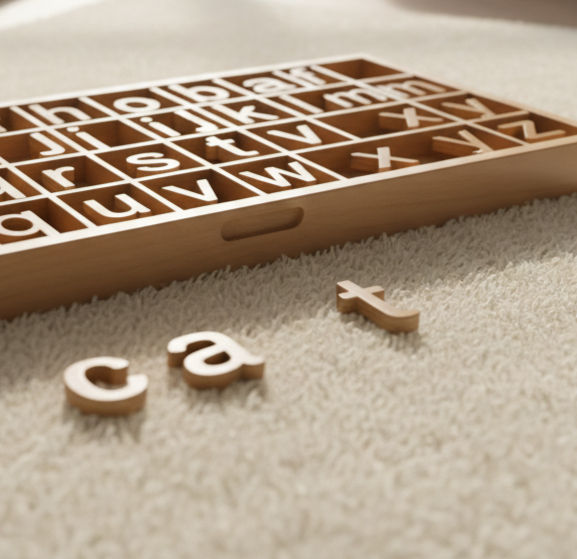
That single sentence is the whole philosophy behind the Movable Alphabet. If forming letters by hand is the bottleneck, then simply take the hand's fine motor limitation out of the equation. The Movable Alphabet gives a child a box of loose, cut-out letters — sorted by sound, colored to distinguish consonants from vowels — that can be picked up and arranged into words without any pencil, and without any handwriting skill required at all. A child who already knows their letter sounds (often from tracing the Sandpaper Letters) can sound out a word slowly, find the matching letter for each sound, and lay it down in sequence: c-a-t, d-o-g, l-o-g. The composing happens entirely in the arranging. The hand's job is reduced to picking up and placing, something a three- or four-year-old's hand is already fully capable of doing.
Montessori described watching this unfold in her own classrooms with a kind of astonishment, noting how quickly and enthusiastically children took to it once the letters were made available:
"The exercises with the movable alphabet place the whole language in motion." — Maria Montessori
What the Movable Alphabet Actually Builds
It isolates spelling and composition from motor performance entirely. A child can build a three-word sentence about their dog with zero handwriting ability, because the material asks nothing of their fine motor system.
It keeps working memory free for the actual task of composing. In line with Berninger's research on transcription competing with text generation for limited cognitive resources (Berninger, 1999), removing the handwriting demand leaves a young child's full attention available for sounding out words and building meaning.
It builds phonemic awareness through the physical act of building. Finding the right letter for each sound a child hears reinforces the sound-symbol relationships at the core of reading, well before formal reading instruction begins.
It sets up what Montessori called the "explosion into writing." Because composing has already been practiced extensively through the Movable Alphabet, many children experience a sudden, joyful leap into writing with a pencil once their hand is finally ready — the ideas and spelling patterns are already familiar; only the transcription is new.
Two Skills, Built in the Right Order
The genius of the Movable Alphabet isn't that it's a clever workaround for a child who "can't write yet." It's that it correctly identifies handwriting and composing as two separate developmental jobs and refuses to make a child's weaker skill (an unready hand) hold back their stronger one (a mind already full of things to say). By the time a Montessori child's fine motor system catches up — the same intrinsic hand strength and in-hand manipulation skills we discussed in our previous post — the thinking work of spelling and composing has often already been done. All that's left is putting it on paper, which is exactly the order writing development research suggests should happen.
References Berninger, V. W. (1999). Coordinating Transcription and Text Generation in Working Memory during Composing: Automatic and Constructive Processes. Learning Disability Quarterly, 22(2), 99–112. https://doi.org/10.2307/1511269 Case-Smith, J. (1993). The Relationship Between In-Hand Manipulation and Bilateral Manual Skills to Fine Motor Skills. Journal of Occupational Therapy. Montessori, M. (2013). The Montessori Method (A. E. George, Trans.). Transaction Publishers. (Original work published 1912).


Comments