Taking Apart the Bridge vs. Building It: Why Building a Word Isn't the Same as Reading One
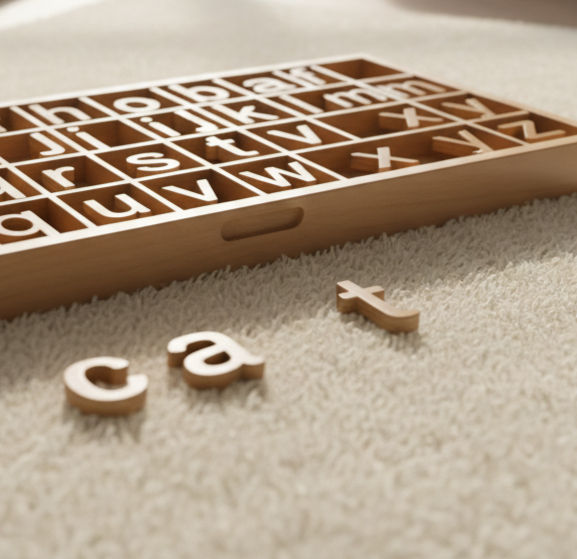

In our last post, we looked at how the Movable Alphabet lets a child compose words and sentences years before their hand is ready to hold a pencil. There's a detail in that process worth slowing down on, because it explains something that confuses a lot of parents: a child who can confidently build the word "cat" with the Movable Alphabet often cannot yet read the word "cat" printed on a card. That's not a contradiction. It's two genuinely different skills, and one is significantly harder than the other.
Building a Word and Reading a Word Look the Same but Aren't
Picture a bridge. If you already know it's a bridge — you've seen it, walked across it, understand exactly what it is — taking it apart piece by piece is a straightforward, almost mechanical task. You know what you're looking for in every piece, because you already know the whole. Now imagine being handed a pile of the same disassembled pieces with no picture, no context, and being asked to build a working bridge from scratch. Same pieces. Vastly harder task, because now you have to construct the whole from parts you haven't yet connected into anything meaningful.
That's the exact relationship between building a word with the Movable Alphabet and reading a word on a card.
When a child wants to write "cat," they already know the word. It's sitting complete in their mind — they can picture the animal, they know exactly what sound the word makes as a whole. Their job is simply to take that already-known word apart: say it slowly, listen for the first sound, find the matching letter, then the next sound, then the next. Cat becomes c – a – t. This is deconstruction. It's real cognitive work, but it starts from a whole the child already possesses.
Reading asks for the opposite. A child looking at the printed letters c – a – t has no completed word waiting in their mind. They have three isolated pieces and no bridge yet. They have to reconstruct the whole from parts, in the correct order, fast enough that the sounds fuse into a single recognizable word rather than three disconnected noises. This is synthesis, and it is considerably more demanding than the analysis required for spelling.
The Research Behind Why This Feels So Different
This isn't just a Montessori observation — it's well documented in reading science. The National Reading Panel identified blending (combining individual sounds into a word) and segmenting (breaking a word into its individual sounds) as the two most critical phonemic awareness skills underlying reading and spelling, respectively (National Reading Panel, 2000). But the two are not developmentally equivalent. Blending requires a child to hold several sounds in memory simultaneously and merge them at speed into something new, while segmenting simply requires noticing what's already there — research on phonemic awareness has long recognized synthesis tasks like blending as considerably more complex than analytic tasks like segmenting (Yopp, 1988). Put simply: taking a known word apart is a much lighter cognitive lift than assembling an unknown one back together.
The Guide: Montessori Built the Sequence Around This Difference
Maria Montessori observed this exact asymmetry long before phonemic awareness research had named it, and she was explicit about what makes reading uniquely demanding:
"A child does not read until he receives ideas from the written word." — Maria Montessori, The Discovery of the Child, p. 229
Notice what that requires: not just identifying sounds, but reconstructing them into a whole word fast enough to receive its meaning. This is why Montessori deliberately sequenced writing before reading. A child spends months — often around six — composing words with the Movable Alphabet, always starting from a word they already know and simply taking it apart. Only once that foundation of letter-sound knowledge is secure does the classroom introduce the much harder reverse skill: reading.
How the Classroom Builds the Harder Skill, Deliberately
Start with what the child already knows (deconstruction). With the Movable Alphabet, a child sounds out "cat" slowly, isolates c, a, and t, and finds each letter in the box. The word already exists in their mind; they're simply taking it apart, piece by piece — dismantling a bridge they've already recognized.
Introduce reading through three-part cards, once letter-sound knowledge is solid. A picture of a cat sits beside the printed word "c-a-t." Now the child faces the harder task: three unconnected pieces, no completed bridge yet in mind.
Practice the sounds in isolation, repeatedly, before connecting them. The child says each sound on its own — c... a... t... — often several times, building familiarity with each individual piece before attempting to join them.
Slow the connection down first. Taking a breath, the child then says the sounds slowly, connected: caaaat, stretching the blend out so the transition between sounds is audible and manageable rather than instant.
Speed it up until the pieces fuse into the whole. With repetition, the slow, connected sounds are said faster and faster, until c-a-t suddenly collapses into the single, recognizable word "cat" — the bridge, finally, fully built.
Understanding Why Patience Matters Here
None of this means a child who can build "cat" but can't yet read it is behind, confused, or being taught inconsistently. It means the classroom has correctly sequenced two skills of genuinely different difficulty: dismantling something familiar first, then slowly, deliberately practicing the much harder work of building something unfamiliar back into a whole. Reading isn't simply "writing in reverse" — it's a heavier cognitive task built on a foundation writing was quietly laying the entire time. Once a child can finally say those sounds fast enough for them to fuse into meaning, they haven't just learned to read a word. They've built their first bridge from raw materials alone, and every word after that gets a little easier to construct.
References National Reading Panel. (2000). Report of the National Reading Panel: Teaching Children to Read. National Institute of Child Health and Human Development. Yopp, H. K. (1988). The Validity and Reliability of Phonemic Awareness Tests. Reading Research Quarterly, 23(2), 159–177. https://doi.org/10.2307/747758 Montessori, M. The Discovery of the Child (p. 229).


Comments