Print vs. Cursive: Why Your Child's Learning Cards Should Include Both
Updated: Sep 16
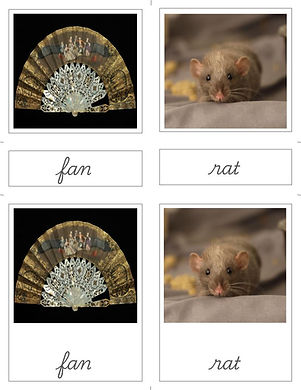
If you've shopped for Montessori materials before, you've probably noticed most cards only come in print. Cursive gets treated like an optional extra — something for "later," once a child is already reading and writing.
But in a true Montessori environment, cursive isn't an afterthought. It's often introduced before print — and there's good reason for that.
Here's why cursive belongs in your child's learning cards from the start, not years down the road.
1. Cursive is easier for small hands to write
Print letters require a child to lift the pencil between every stroke — stop, reposition, start again. Cursive is one continuous motion. For a developing hand still building fine motor control, that flowing movement is actually simpler to produce than the stop-and-start precision print demands.
This isn't just modern preference — Maria Montessori herself observed that the straight and oblique lines of printing were more difficult for children to form than cursive which is why some Montessori classrooms introduce cursive letters before print at all.
2. Cursive makes word boundaries obvious
In cursive, the letters of a word are physically connected. A child can see, without being told, where one word ends and the next begins. Print doesn't offer that visual cue — spacing has to be taught and judged separately. Cursive builds that understanding right into the handwriting itself.
This same connectedness also helps with letter recognition. Print writing often causes children to mistake similar letters for one another, such as confusing d's for b's or swapping q's and p's, while cursive letters within the same word are less similar in formation and appearance— making the distinction easier for early writers to grasp.
3. It supports reading readiness, not just writing
Learning to recognize cursive letterforms early gives children a second visual pathway for connecting sounds to symbols. When they later encounter cursive in books, signs, or handwritten notes from family members, it's already familiar — not a foreign alphabet to decode from scratch.
Research also shows that students who learn cursive tend to have better reading comprehension and information retention compared to those who only type or print— a benefit that starts building the moment a child begins tracing their first connected letters.
Maria Montessori herself cared deeply about how children were taught to write, not just when. She wrote that instruction should attend closely to "the beauty of form" and "the flowing quality of the letters"— a philosophy that still shapes why cursive holds such a central place in Montessori classrooms today.
4. It's a skill that's disappearing from most classrooms — but not from real life
Fewer schools teach cursive today, which means fewer children can read a handwritten letter, a recipe card, or their own grandparent's signature. Choosing cursive now isn't about nostalgia. It's about making sure your child isn't locked out of a form of written communication that's still very much in use.
5. Teachers can introduce it without extra prep or separate materials
For teachers and homeschool parents, needing to source print materials now and cursive materials later means double the shopping, double the printing, and double the cost. Cards that include both from the start remove that extra step entirely — you're not scrambling to find a matching cursive set once your child is ready for it.
The takeaway
Cursive isn't a bonus skill to save for later — for many children, it's actually the easier starting point, and it builds reading and writing skills at the same time. That's exactly why our three-part cards include both print and connected cursive in every set: so you're not choosing one now and hunting for the other later.
Explore our full card sets — 10 real-photo cards per set, in both print and cursive, ready to print, cut, and use today.
Sources:


Comments