Why 3 Part Cards
Updated: Sep 16
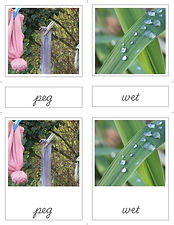
Montessori three-part cards are a cornerstone of the Montessori language curriculum, offering a versatile and effective tool for vocabulary development, classification, and concept mastery. Montessori teachers utilize these cards in a specific, progressive manner to facilitate independent learning and reinforce a child's understanding of the world around them.
Typically, a set of three-part cards consists of three components for each item:
The Control Card: This card features both the image and the corresponding label (word) together.
The Picture Card: This card displays only the image.
The Label Card: This card contains only the written label (word).
Montessori teachers introduce three-part cards in a systematic way, often starting with younger children (around 2.5-3 years old) for basic vocabulary and extending to older children (up to elementary) for more complex concepts. Here's a breakdown of how they are used:
1. Initial Introduction and Vocabulary Building (Matching):
The teacher begins by presenting the control cards to the child, naming each object clearly and precisely. This establishes the initial connection between the spoken word and the image.
Once the child is familiar with the names, the teacher might introduce the picture cards and the label cards separately. The child is then encouraged to match the picture card to its corresponding label card. Initially, the teacher might do this as a demonstration, guiding the child.
The control card acts as a built-in "answer key." After the child has attempted to match the picture and label, they can use the control card to self-correct their work, fostering independence and critical thinking.
2. Classification and Categorization:
As children progress, three-part cards are used for more advanced classification exercises. Teachers present sets of cards based on a specific theme (e.g., animals, continents, types of trees, parts of a plant).
Children learn to group the cards according to their shared characteristics. For example, they might sort animals into categories like mammals, birds, and reptiles, or classify plants by their different parts (root, stem, leaf, flower). This process develops logical reasoning and organizational skills.
3. Language Enrichment and Reading Preparation:
For children who are beginning to read, the label cards become crucial. By matching the written word to the image, children reinforce their phonetic understanding and build their sight word vocabulary. The visual aid of the picture card helps them decode the word and understand its meaning.
Teachers can also use the cards to introduce grammatical concepts (e.g., singular/plural by having cards for "dog" and "dogs"), and to expand descriptive vocabulary.
4. Research and Exploration (Elementary Level):
In elementary Montessori classrooms, three-part cards evolve into research tools. For example, a child studying different biomes might have three-part cards for various animals found in each biome. They would use these cards to guide their research, write reports, or create presentations.
The cards might also include additional information on the back of the control card for older children, prompting further exploration and deeper understanding.
5. Promotion of Independence and Self-Correction:
A core principle of Montessori education is self-directed learning. Three-part cards are designed to be self-correcting. The child doesn't need constant teacher intervention to know if they've made a mistake; the control card provides immediate feedback. This empowers children to take ownership of their learning and develop problem-solving skills.
In essence, Montessori teachers leverage three-part cards as adaptable, multi-sensory materials that grow with the child. They move beyond simple memorization, fostering a deep understanding of concepts, encouraging independent exploration, and laying a strong foundation for language acquisition and critical thinking.


Comments